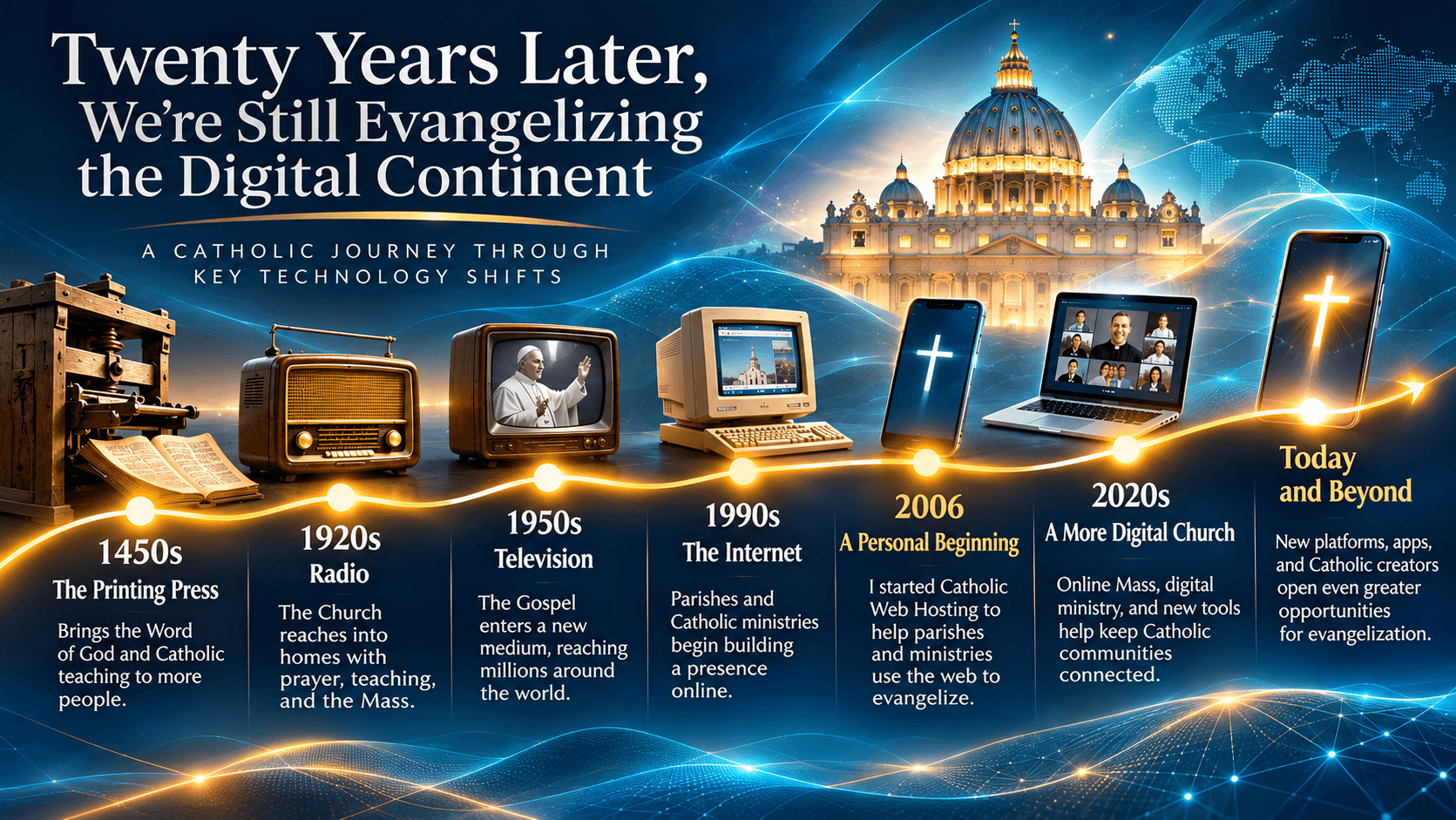
In 2006, I wanted to understand how websites worked. I never imagined that curiosity would turn into a twenty-year effort to help the Church reach people in the digital world.
It Started With Curiosity
Twenty years ago, I started learning how websites worked. I was fascinated by the idea that someone could create something on a computer and make it available to people almost anywhere in the world.
The more I learned, the more I saw an opportunity for the Catholic Church.
What if a parish could reach a young person who might never pick up a bulletin? What if a family new to town could discover a parish before ever walking through its doors? What if a small Catholic ministry could share its work with people far beyond its neighborhood?
I wasn't thinking first about building a large company. I was thinking about what this technology could do for the Church.
That curiosity eventually became Drummer Boy Hosting, the company that has grown into Catholic Web Hosting.
From the beginning, the goal was more ministry-minded than business-minded: help Catholic organizations use the internet to reach people.
An Offer I Thought Parishes Would Welcome
When I first began reaching out to parishes, I tried to make getting online as affordable as I possibly could.
For $299 a year, I offered a website design, hosting, a domain name, and support. I believed that lowering the cost would make it easier for parishes to take the next step.
I picked up the phone and called parishes myself.
I heard a lot of no's.
One response stayed with me: "We already have a parishioner taking care of our website."
I understood that answer. Parishes rely on generous volunteers, and many of those volunteers give extraordinary amounts of time and talent. The Church would be poorer without them.
But I also kept wondering: Does having someone responsible for a website necessarily mean that the parish has the support and expertise it needs?
A willing volunteer might be excellent at organizing events or welcoming families but have little experience with website security, accessibility, mobile design, or keeping a site reliable. And even a skilled volunteer can get busy, move away, or simply burn out.
This isn't an argument against volunteers. It's an argument for giving them better tools, clear responsibilities, and dependable support.
At the time, I couldn't understand why more parishes weren't interested. Looking back, I realize that the price was only one piece of a much larger puzzle.
Twenty Years of Progress-and Familiar Challenges
The internet of 2006 looks almost unrecognizable today.
We moved from desktop-first websites to smartphones in nearly every pocket. Social media changed how people discover ideas and communities. Video became an everyday language. Now artificial intelligence is changing how people create, search, and work.
Yet some of the challenges I encountered twenty years ago still feel familiar.
Parish websites can be difficult to update. Important information may be buried in menus or outdated PDFs. Ministries may have no easy way to communicate with the people they serve. A volunteer may inherit a system nobody else knows how to maintain.
Of course, this isn't true of every parish. Some Catholic organizations are doing outstanding digital work. And these problems aren't uniquely Catholic; businesses and nonprofits face them too.
What concerns me is the missed opportunity.
A parish's online presence should be an extension of its welcome, not an obstacle someone has to overcome to find it.
Imagine someone considering returning to Mass after years away. They may not be ready to call the parish office. Their first step might be searching for Confession times on a phone.
If the information is clear and welcoming, that person can take the next step. If it's missing or confusing, we may have made an already difficult decision harder.
A website cannot bring someone to faith by itself. But it can help someone find the people, sacraments, and community they are seeking.
Why Technology Keeps Falling Down the Priority List
I don't believe most parishes overlook technology because they don't care.
Many parish offices are stretched thin. Priests and staff juggle pastoral responsibilities, administration, facilities, religious education, and the needs of their communities. Budgets are limited, and volunteers already do so much.
Under those circumstances, improving a website or modernizing a ministry workflow can feel like one more project that nobody has time to manage.
I understand that.
But here's the paradox I've come to see: Some of the pressures that push technology to the bottom of the list are the very pressures good technology can help relieve.
A straightforward online registration process can reduce back-and-forth emails. A reliable calendar can keep ministry schedules in one place. A well-organized website can answer common questions without requiring someone to call the parish office. Easy publishing tools can help volunteers share updates without needing a developer.
None of these tools can replace a priest, a catechist, or a compassionate person sitting with someone in need.
And technology implemented badly can create more work than it saves.
The goal isn't to automate parish life. It's to reduce unnecessary friction so that people have more time for parish life.
Evangelizing the Digital Continent
The Church has been thinking seriously about the internet for decades.
In his 2002 message for World Communications Day, St. John Paul II described the internet as a new forum for proclaiming the Gospel. He recognized both its promise and the need to use it wisely.
Later, Pope Benedict XVI spoke about the digital continent and the responsibility to bring the Gospel into these new spaces. In his 2009 World Communications Day message, he addressed young people in particular, recognizing their familiarity with digital culture and inviting them to witness to their faith there.
That vision has always resonated with me.
If young people are spending significant parts of their lives online, shouldn't we take seriously the ways they encounter the Church there?
Not to chase every trend. Not to turn the faith into entertainment. And certainly not to confuse followers or clicks with conversion.
But to be present, accessible, and ready to welcome someone who is searching.
The digital continent isn't separate from the people we're called to serve. It's one of the places where we can meet them.
There Are Reasons to Be Hopeful
Despite the challenges, I'm more hopeful today than I was twenty years ago.
Look at the visibility of Catholic prayer and education online. Apps such as Hallow have shown that digital tools can help people build habits of prayer. Organizations such as Catholic Answers make apologetics and teaching accessible to people who might never attend a lecture. Catholic creators are reaching audiences through videos, podcasts, and social media.
These examples don't mean every parish needs to launch an app or become a media company. They show that there is an audience-and a desire-for Catholic content and community in digital spaces.
They also remind me that smaller organizations deserve a chance to participate.
A rural parish shouldn't need an enormous budget to publish a clear, welcoming website. A volunteer-run apostolate shouldn't need a software engineering team to share its mission. A ministry shouldn't have to choose between paying for technology and serving the people who depend on it.
Today's tools give us new opportunities to make these things simpler and more affordable. That possibility is exciting to me.
What I Want to Help Build
After two decades, I've learned that affordable pricing alone doesn't solve the problem. Neither does a beautiful design or a long list of features.
Technology has to fit the people who will actually use it.
It needs to be understandable to a parish secretary with a hundred other responsibilities. It needs to be manageable by a volunteer who can only give a few hours a week. It needs to be dependable enough that the parish doesn't have to think about it constantly.
And above all, it needs to serve the mission.
That conviction is part of why Drummer Boy Hosting has become Catholic Web Hosting, and why we're building VerbumCMS. I want us to offer more than a place to put a website. I want us to help Catholic organizations communicate clearly, manage their work more easily, and reach people they might otherwise never encounter.
We're not going to solve every challenge facing the Church. Technology cannot fix a shortage of vocations, replace pastoral leadership, or create faith where there is no personal response to grace.
But if we can save a parish staff member a few hours, help a volunteer publish an important announcement, or make it easier for one person to find their way to a parish, that work matters.
Twenty Years Later, the Mission Is Still the Same
In 2006, I was curious about websites and hopeful about what they could make possible for the Church.
I made calls. I heard no's. I offered what I could at a price I thought almost anyone could afford. And I learned that change is rarely as simple as offering a better tool.
Twenty years later, I still believe in the opportunity I saw back then.
Only now, the technology is more capable, the digital world is more central to everyday life, and the examples of Catholic creativity online are more encouraging than ever.
I don't want Catholic Web Hosting to stand on the sidelines of that progress. I want us to help make it possible for more parishes, ministries, and apostolates to take part.
Not because every parish needs the newest technology.
But because every parish deserves tools that help it fulfill its mission.
The Gospel hasn't changed. The places where people look for answers have. We should be ready to meet them there.
If you work or volunteer at a parish, I'd love to hear from you. What is the biggest technology challenge your parish faces? And what would make your ministry's work easier?